
Justice Reframed: Rethinking the Next Generation of Courthouses — Part 1: The Evolving Courthouse
Authored by: Kyle Yardley, Justice Practice Leader, Government Managing Partner
Introduction
Courthouses have historically been designed around a stable and predictable model of justice delivery. Proceedings occurred in person, records were physical, and the courthouse served as the central setting for judicial operations. These buildings were intended to project authority, permanence, and civic stability, reflecting how courts traditionally functioned for generations.
The COVID-19 pandemic did not create change within the judicial system, but it accelerated changes that were already emerging. Courts rapidly adopted remote technologies, modified workflows, and restructured service delivery to maintain continuity.[1] What began as a response to disruption has evolved into a broader transformation in how justice is accessed and delivered.
Today, courts in all 50 states utilize remote and hybrid hearings, where at least one participant appears remotely through videoconferencing technology.[2] As a result, justice is no longer defined solely by physical presence within the courthouse. Courts now operate across both physical and digital environments simultaneously.
This shift has direct implications for courthouse planning and design. Facilities originally designed for a single mode of service delivery must now support hybrid operations, evolving technologies, and changing expectations regarding accessibility, efficiency, and security.
This article is the first in a two-part series examining how courthouse design is evolving in response to these changes. It focuses on the courthouse as part of a broader operational justice system. The second article explores how hybrid proceedings are reshaping courtroom design and redefining the relationship between physical space and judicial function.
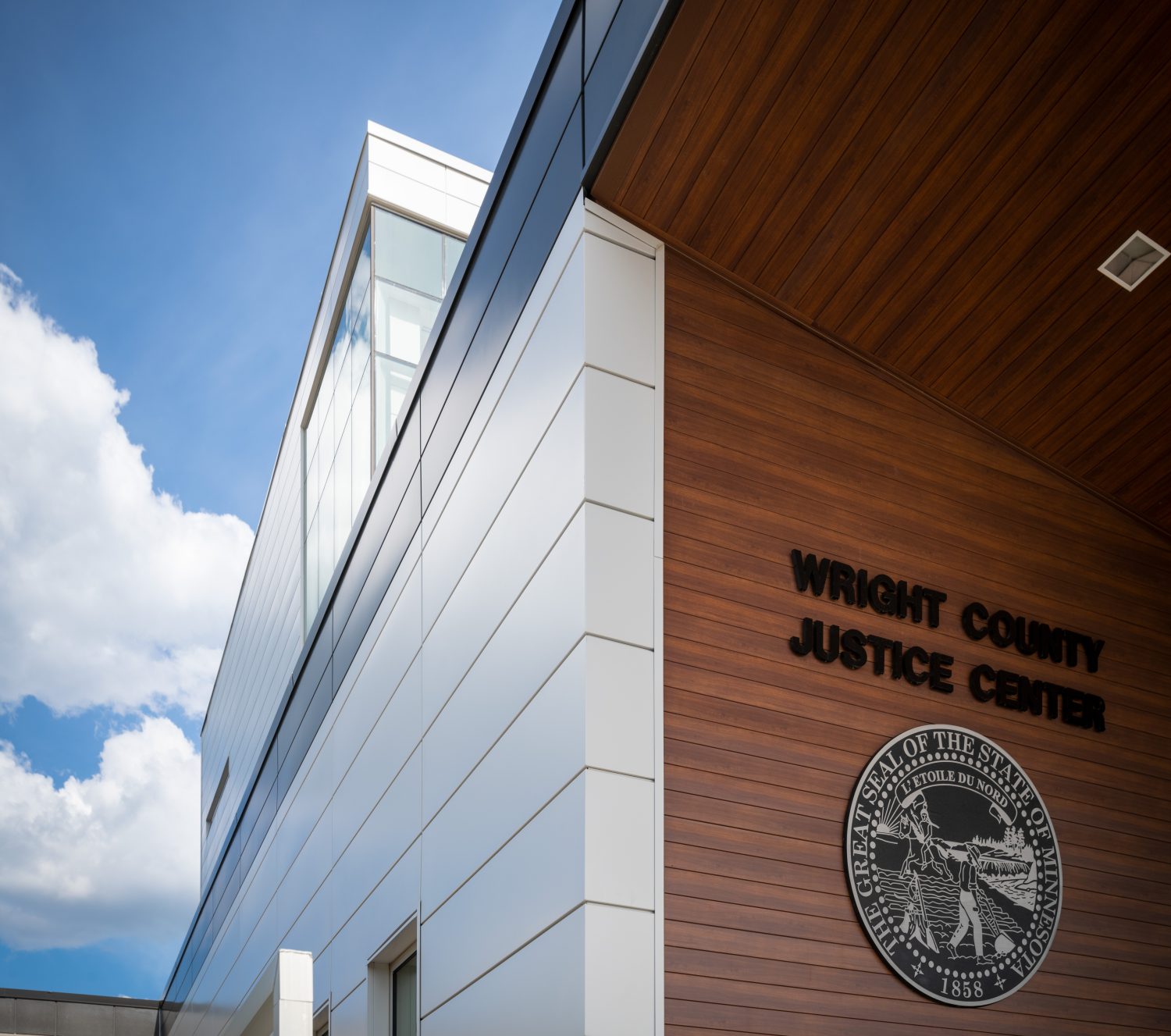
The Courthouse Within a Broader Justice System
The traditional courthouse model was based on centralization. Core functions such as adjudication, records management, public access, and administrative operations were consolidated within a single facility. While this model provided clarity and civic presence, it also assumed that participants, information, and services would converge in one place.
That assumption no longer reflects current court operations. Hearings, filings, and case coordination now occur across a combination of physical and digital environments. Participants may appear from detention facilities, offices, chambers, or remote locations, while records and case management operate through integrated digital systems. Many related justice services are also delivered through community-based providers rather than within the courthouse itself.
The courthouse remains an essential anchor within this evolving system, but its role has shifted. It is no longer the sole venue through which justice is delivered, but a critical node within a broader operational framework. Increasingly, courts function within interconnected networks of justice agencies, public services, and community relationships rather than as isolated institutions.
This shift carries direct implications for planning and design. Courthouse size, circulation, location, and program must reflect how the justice system actually operates, including case movement, interagency coordination, custody management, and which services occur inside or outside the facility.
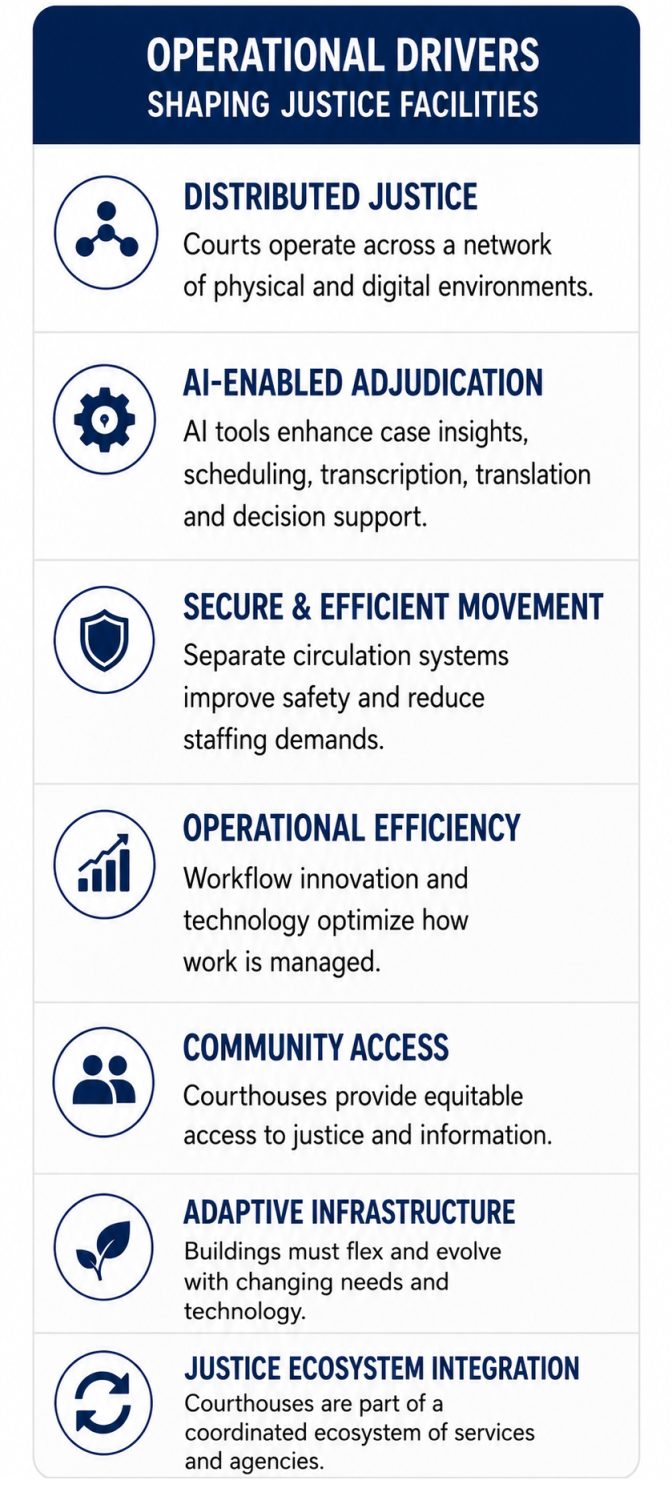
Operational Drivers of Change
Courts are undergoing a fundamental operational transformation driven by workload pressures, technological advancement, staffing challenges, and changing service expectations.
One major driver is the increasing complexity of court dockets. Courts must simultaneously manage high volumes of routine matters alongside more complex proceedings requiring greater judicial involvement and coordination across multiple agencies. Without effective case management, routine matters can consume disproportionate resources while more complex cases experience delay and fragmentation.
In response, many courts are adopting differentiated case flow models, early case triage, specialized dockets, and more active scheduling practices. These approaches are intended to improve efficiency, reduce delays, and better align judicial resources with case complexity.
Technology has become a central enabler of these changes. Digital case management systems, electronic filing, and online records access have significantly reduced reliance on paper-based workflows. At the same time, hybrid proceedings have introduced new operational flexibility while increasing demands on courtroom technology, audiovisual systems, and space planning.
These changes are contributing to a more distributed model of justice delivery. Court functions that were once centralized within a single facility now occur across multiple physical and digital environments. Hearings may involve participants joining remotely from detention facilities, offices, or other locations, while related services such as diversion programs, treatment, and supervision are increasingly delivered through community-based providers.
Operational considerations related to staffing and security further reinforce the need for change. Many jurisdictions face staffing shortages, making efficiency in circulation, supervision, and movement increasingly important. Poorly planned movement between holding areas, courtrooms, and support spaces can increase staffing requirements and introduce avoidable security risks.
At the same time, the civic role of the courthouse continues to evolve. While courthouses must still convey authority and public trust, they are also expected to be accessible, transparent, and responsive to the communities they serve.
From Static Buildings to Adaptive Infrastructure
Historically, courthouses were designed for long-term stability. Their organization and circulation systems assumed that court operations would remain relatively consistent over time.
That assumption is becoming increasingly difficult to sustain. Courthouses must now function as adaptive infrastructure capable of responding to evolving operational models, emerging technologies, and changing service demands without requiring major reconstruction.
This shift has direct implications for design. Courtrooms are increasingly expected to support multiple proceeding types, including hybrid hearings. Support spaces must accommodate fluctuations in staffing, workload, and operational needs. Technology and audiovisual infrastructure must also allow ongoing upgrades as systems evolve more rapidly than the building itself.
Adaptability is therefore no longer simply a desirable feature. It is becoming a core performance requirement that directly affects the long-term functionality and relevance of courthouse facilities.
Rethinking Program and Space Allocation
One of the clearest indicators of change is how courthouse space is being used. Traditional courthouse planning emphasized large waiting areas, extensive file storage, and a high number of dedicated courtrooms because facilities were designed around in-person proceedings and paper-based processes.
That model is increasingly misaligned with current operations. Electronic filing, digital records, virtual hearings, and online service portals have reduced the need for physical presence in many routine matters. Research from The Pew Charitable Trusts and the RAND Corporation indicates that digital court systems and online participation models are becoming increasingly integrated into routine judicial operations, while also reshaping how users access court services.[3]
As a result, courthouse space requirements are changing. Demand for large physical file storage areas is decreasing, while improvements in scheduling and case management are reducing the need for oversized waiting areas and prolonged public dwell time.
At the same time, demand is increasing for spaces that support collaboration, integrated technology, and hybrid participation. Staff workflows are also evolving, with many jurisdictions adopting more flexible work arrangements that include shared work areas and technology-enabled collaboration spaces.
These shifts suggest that courthouse programming can no longer rely primarily on historical standards or static planning ratios. Increasingly, facilities must be planned around operational workflows and adaptability rather than fixed assumptions about space use.
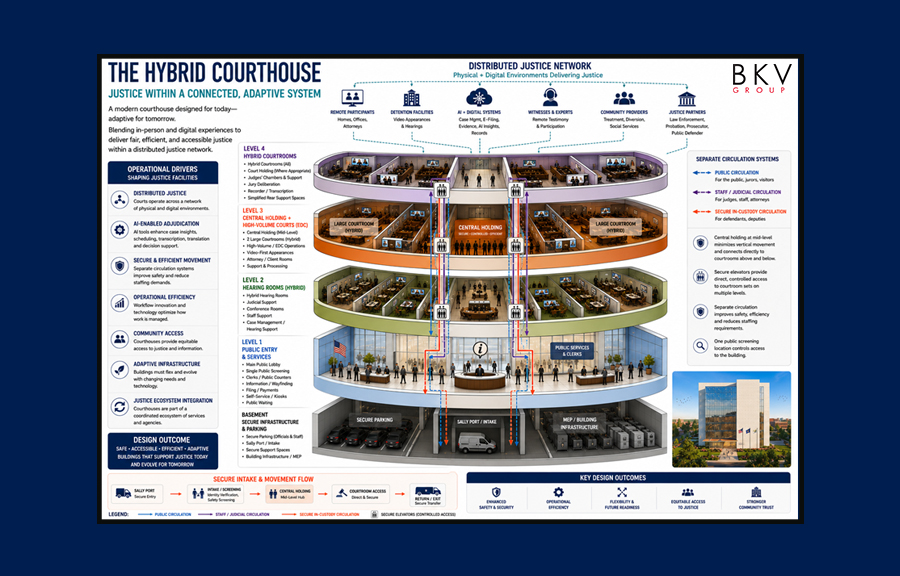
The Hybrid Courthouse
Justice Within a Connected, Adaptive System
A modern courthouse designed for today — adaptive for tomorrow by blending in-person and digital experiences to deliver fair, efficient, and accessible justice within a distributed justice network.
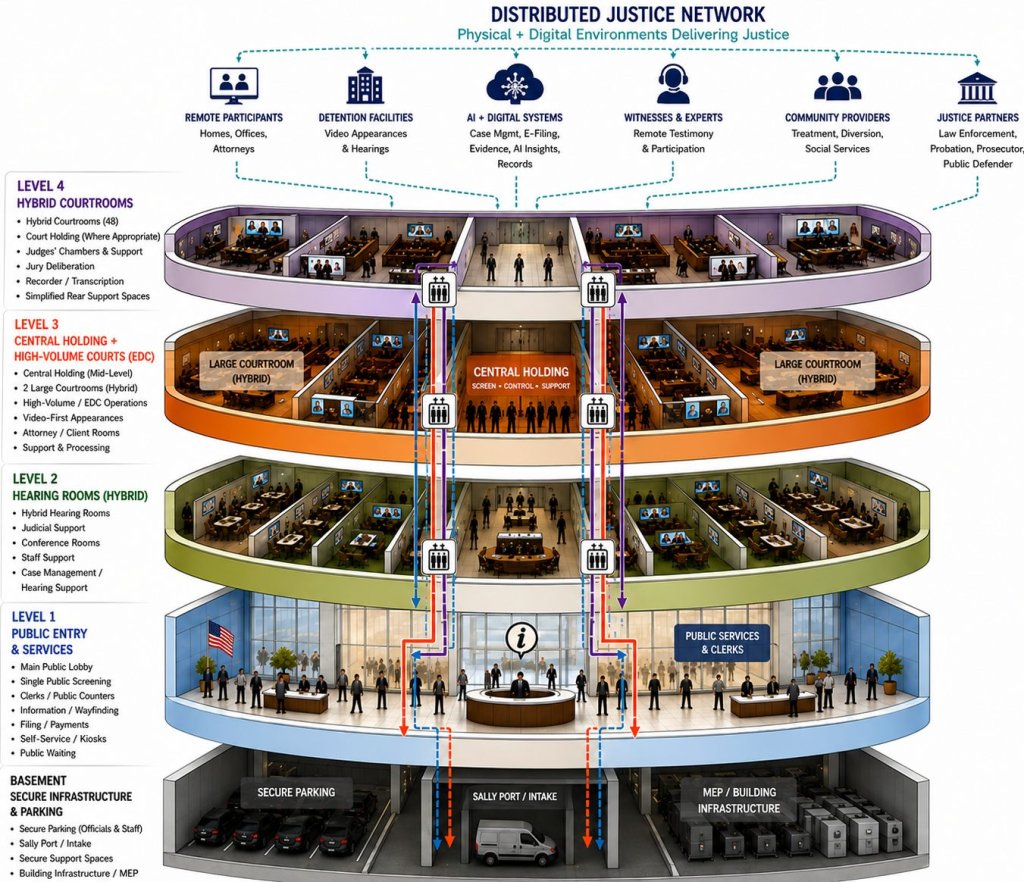
Integration with the Justice Campus
Courthouses are frequently part of a broader justice campus that includes detention facilities, administrative offices, and related services. The relationships between these components directly affect operational efficiency, staffing, and security.
The movement of in-custody defendants between detention facilities and courtrooms, for example, requires secure and carefully controlled circulation systems. Poorly planned adjacencies can increase staffing requirements, introduce security risks, and reduce operational effectiveness.
Similarly, the proximity of related agencies influences communication, coordination, and case movement throughout the justice system. Designing the courthouse as part of an integrated campus requires a system-wide approach to circulation, security, and operational planning.
Conclusion
The courthouse is no longer defined solely by its physical form. It is part of a broader justice infrastructure operating across multiple environments, technologies, and modes of participation.
This evolution requires a corresponding shift in courthouse planning and design. Rather than focusing exclusively on the building itself, decision makers must understand how the courthouse functions within the larger justice system, including operational workflows, staffing, security, interagency coordination, and long-term adaptability.
While these broader system-level changes are reshaping courthouse planning, some of the most immediate impacts are occurring within the courtroom itself. The rapid expansion of remote and hybrid proceedings is changing how judicial spaces function on a daily basis, influencing courtroom configuration, scheduling, staffing, technology integration, and participant interaction.
The next article in this series, The Hybrid Court: Designing for Digital + Physical Justice, examines how these changes are transforming courtroom environments and redefining the relationship between physical space and judicial process.
Footnotes
[1] The Post-Pandemic Evolution of Courthouses and Public Safety Facilities, (2023), iii.
[2] National Center for State Courts, Hybrid Hearings Improvement Initiative, (2023-2024), 4.
[3] The Pew Charitable Trusts, How Courts Embraced Technology, Met the Pandemic Challenge, and Revolutionized Their Operations, Dec 2021, 12-13.
Amanda R. Witwer et al., Online Dispute Resolution: Perspectives to Support Successful Implementation and Outcomes in Court Proceedings (RAND Corporation, 2020) 8-9, 13.