
Boutique Hotel Design — Chapter 2: Comfort, Character, & Memory
Authored By: Jonathan Cakert, Hospitality Practice Leader
Over the course of multiple chapters, BKV Group’s Hospitality Leader, Jonathan Cakert, will peel back the layers of boutique hotel design through his travels and stays at some of the most preeminent and memorable hotels of this product type. Within the series, Jon will recount his experiences at each venue through deep-dive case studies to discover what makes a boutique hotel successful.
Introduction:
Rooms in boutique hotels are not just containers for sleep — they’re mood-setting machines. The best rooms don’t merely impress; they recalibrate. In an age of overstimulation, the guestroom has become a refuge from noise, schedules, notifications, and even identity itself. Whether returning from a day of back-to-back business meetings, navigating the social exhaustion of a conference, or simply wandering a city with your family until your legs give out, the room becomes more than accommodation. It becomes your moment of reset.
Great ones feel effortlessly composed, like a lifestyle you could live if only your apartment or house were a lot cooler and better lit. Guests expect both form and function: layered lighting, well-placed mirrors, and a bed that welcomes an elite nap. The outlets should be where you need them, and the shower should hit with confidence. For operators, this is where reviews are made or broken. If the sound from the plumbing in the walls is noticeable or the blackout shade leaks a sliver of light, no amount of stitched-leather on the headboard will save you. Designers must strike the balance between photogenic and practical; operators must protect the guest experience through performance. The room is where the brand promise becomes personal.
Room ROI: Where Design Meets Dollars
What does the guest room really do for ROI?
A flawed room sinks the ship. A great one becomes the opening line of a vacation story that gets retold for years — quietly driving repeat stays, emotional brand loyalty, and stronger rate performance along the way. The return is financial, of course, but it’s emotional first.
But here’s the paradox: “basics first” sounds obvious until you realize how easily the basics go wrong. So yes—check the essentials, then dare to add signature moves. Differentiation isn’t a luxury—it’s a line-item strategy. Yet the most memorable differentiation is rarely loud. Guests remember the room that helped them sleep deeply, quieted the city outside, softened the transition from travel to rest, or offered a moment of stillness they didn’t realize they needed. Emotional comfort has measurable value — even if it never appears in a pro forma.
In this chapter’s Designer Dialogue, David Ashen speaks about “possibility” and the importance of maintaining peripheral awareness as a designer. Adaptive reuse projects naturally benefit from this mindset because they resist formula. Unusual proportions, leftover structural rhythms, asymmetrical windows, deep thresholds, or oddly shaped bathrooms force designers to rethink the choreography of the room rather than defaulting to the industry’s efficient rectangular box.
Sometimes the most memorable guestrooms emerge precisely because the building refuses to cooperate politely.
That said, a standard room can be just as memorable when the design has conviction. Expression, materiality, lighting, sequencing, or one unexpected spatial gesture can carry an entire experience.
The Instagram Paradox
Most guest rooms are too small and too proportionally horizontal to photograph well. A wide shot of a king bed and a window rarely stops anyone scrolling. But a perfectly styled nightstand vignette? A sculptural headboard washed in evening light? The corner where the sconce kisses the plaster texture? That’s your shareable currency.
Design for real-life comfort—but don’t ignore the digital stage. Today’s guest measures luxury not only by feel, but by how well a detail frames in a phone camera. Hero moments win hearts (and hashtags). But the best guestrooms understand something deeper: the room must perform both digitally and emotionally. A photogenic vignette may earn the post, but comfort, calm, and intuitive functionality are what earn the return stay.
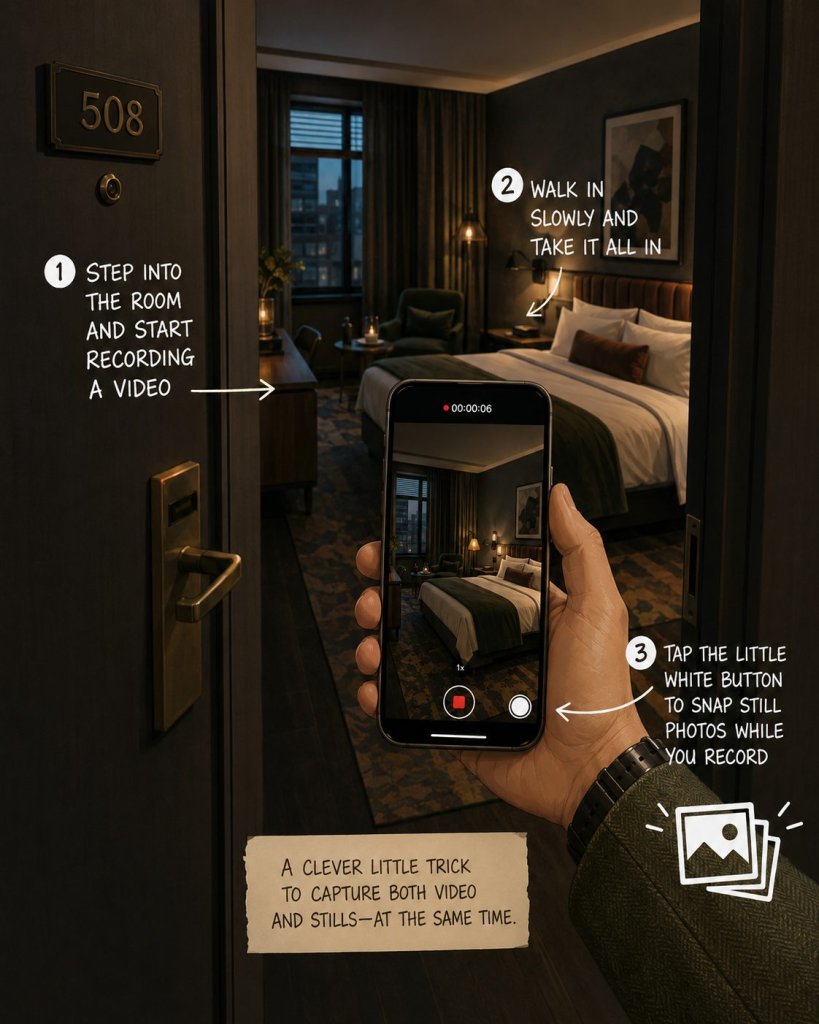
iPhone photography hack (also useful for filming your kid’s soccer game):
When you first step into a room, shoot a slow-moving video as you walk in. While recording, tap the little white button in the corner to grab stills on the fly.
Maybe I’m late to the party, but I only picked this up recently and it’s a clever little trick.
Operational Truth: Beauty Must Behave
Final note — don’t let design outplay operations. That beautifully upholstered niche with the heavily baffled folds everyone loved in rendering? Someone has to vacuum it. That clever open-plan bath with the frameless glass partition? Someone is replacing towels twice as often because guests are using them to dry the floor.
Rooms don’t turn themselves over, and no guest loves waiting in the lobby at 2:45 p.m. for a clean room at check-in. The best hospitality spaces balance expression with practicality.
Case StudY #1:
The William Vale (Brooklyn, New York)
Walk the corridors of The William Vale and you see how subtle sequencing shifts perception:
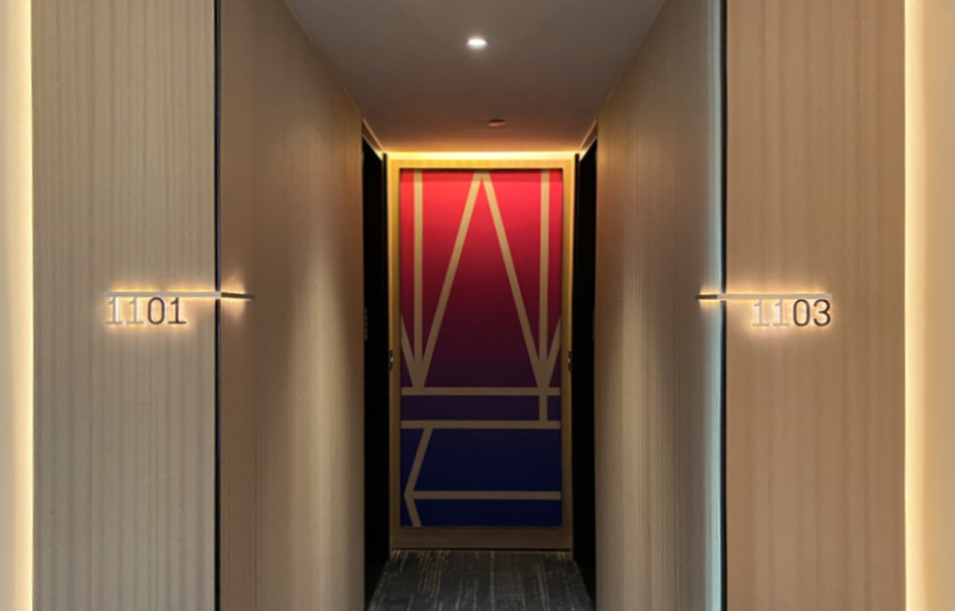
Instead of following the traditional sequence of entry → foyer → bath → bed, the Vale pulls the foyer outward into the corridor, creating a shared threshold between hallway and guestroom. The arrival experience becomes more gradual and cinematic. Rather than crossing a single boundary into “the room,” the guest moves through a layered progression of corridor, threshold, art, light, bathroom, and finally view — a choreography that makes the space feel emotionally larger than its physical dimensions.
A simple shift in plan becomes a lasting spatial memory.
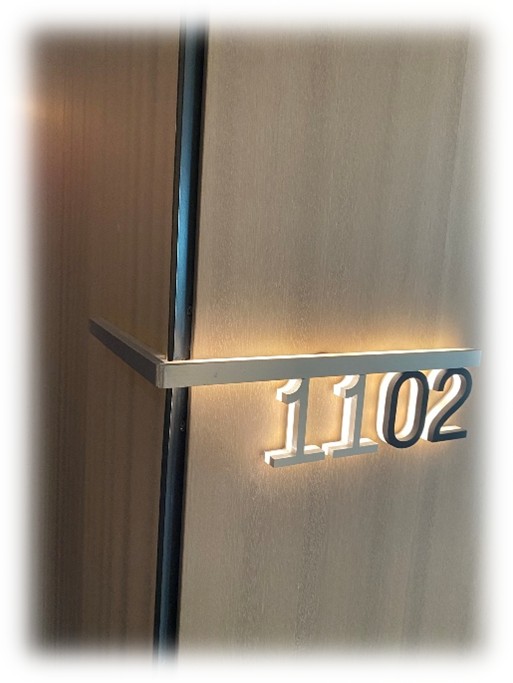
Bonus points for the elegant corner-guard detail.
Case Study #2
My room at The Robey turned the script again: the headboard oriented toward the window, the bathroom stretched behind it in a long run framed by mullions with exposed fasteners and fritted glass. The palette was disciplined, industrial without posturing. The layout felt confident and unapologetic, in the most Wicker Park-appropriate way, a nod to local context without shouting. The plumbing fixture selection gave me flashes of Hooker’s apartment from The Sting — but elevated and intentional. In one room, a unique built-in bench was a softening touch—but it was the organizational layout that stuck with me. That’s the lesson: a single, assertive gesture can carry the entire experience.
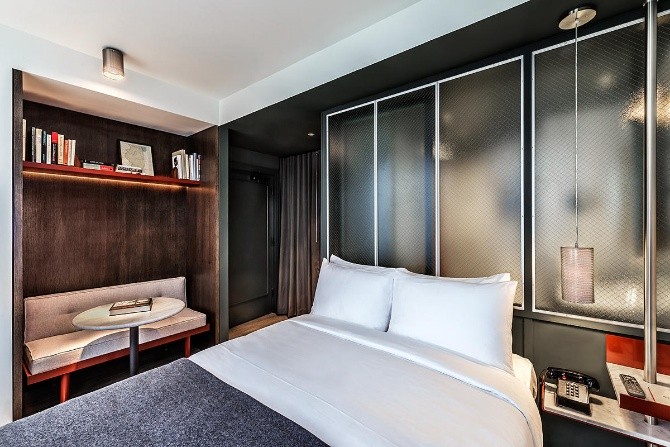
Image Courtesy of Pepper Construction
The Designer’s Conversation
David Ashen, CEO, Saguez & Dash
Before discussing guestrooms, lobbies, or the evolving language of boutique hospitality, I asked David Ashen a simple question:
If “designer” was not an available adjective, how would you describe yourself?
His answer came immediately.
“Possibility.”
It was the kind of response that quietly reframed the entire conversation. Not because it sounded poetic, but because it revealed the mindset behind his work. Throughout our discussion, Ashen returned repeatedly to the idea that the best hospitality experiences emerge when designers resist formulas, stay open to unfamiliar influences, and allow space for unexpected emotional outcomes.
For Ashen, hospitality is not about imposing style onto a room. It is about creating conditions: for comfort, curiosity, calm, connection, and memory. The guestroom becomes more than a place to sleep; the lobby becomes more than circulation space. Both are opportunities to shape behavior and emotion in subtle but lasting ways.
That philosophy — possibility over prescription — sits at the center of his work, and increasingly, at the center of boutique hospitality itself.
Below is an excerpt from our afternoon together.
Jonathan Cakert (JC):
You mentioned earlier that some of the most memorable hospitality experiences happen when designers challenge preconceived notions — even the things we’ve been told a hotel should or shouldn’t be. Where do you think that mindset comes from?
David Ashen (DA):
It’s always fun when you walk into a property and realize they actually did something you thought you couldn’t do in a hotel. Maybe they used a material you were told was inappropriate, or organized the room in a way that breaks convention.
I think sometimes we get trapped by our own experience. We start believing there’s only one correct way to do hospitality.
Ironically, I was hired to do my first restaurant because I had never done a restaurant before. I was hired to do our first hotel because we had never done a hotel. Those clients wanted someone without all the preconceived notions.
Sometimes the best hospitality ideas come from outside hospitality entirely.
JC:
You’ve described your career as multidisciplinary—retail, nightlife, restaurants, hospitality. How has that shaped the way you think about hotel design?
DA:
It has always been about experience for me. The breakthrough hotels—the early Ian Schrager projects, André Balazs properties—they had personality. Before that, luxury hotels often felt interchangeable. Everything looked like an old Ritz-Carlton.
What changed was the idea that a hotel could have a point of view. A vibe. You wanted to be there even if you weren’t staying there.
Now, everyone is chasing authenticity, which is harder than it sounds. The best projects still surprise you. “They actually did that.”
JC:
We’ve inherited so many default assumptions about the guestroom — the proportions, the bathroom location, the entry sequence, even how deep the room should be. These are all spatial relationships that facilitate function. But, as someone who seems to travel constantly, what ultimately matters most to you in a guestroom?
DA:
Comfort. Absolutely comfort.
The day is so hectic. Sometimes I’ll choose a simpler hotel just because I know I’m going to sleep better there. I want to feel cozy and comfortable in the room.
The room needs to be an escape for me.
JC:
What kinds of “small details” have the biggest impact?
DA:
You’re entering a strange room every time you check into a hotel, so simplicity matters.
You can spend enormous money on finishes, but if the guest can’t figure out how to turn off the lights from bed, the experience already starts unraveling.
Hotels sometimes underestimate how vulnerable people are in guestrooms. You’re in an unfamiliar environment every night. Good design removes friction.
JC:
You told a story during our initial conversation about a hotel room without a television…
DA:
Yes — I was working on a hotel in Curaçao and decided not to stay at the hotel we were renovating. I wanted to try something more local, so I stayed at this little hotel, right on the water.
I got the room that directly overlooked the ocean, and the first thing I did was start looking for the TV. I was being the American that I am — trying to turn the TV on. And I couldn’t find it.
So I went downstairs and said, “I hate to ask this question, but where’s my TV?”
And they said, “Mr. Ashen, you have the only room with a direct ocean view — why would you need a TV?”
And I realized that that was luxury.
The room was beautifully designed. Very simple — white linen, very connected to the outdoors, very quiet. It made me rethink the room in another way because I’m always thinking about where the damn TV goes.
But if we can think about places that allow us to have peace and quiet — because we’re so brushed with information all the time — and provide spaces where people can connect with themselves or whoever they’re with in a new way, that’s really interesting.
JC:
What do you think has shaped your perspective on hospitality more than anything else? How do you keep things fresh?
DA:
I’ve always believed you should never look straight ahead all the time. You have to keep your peripheral vision active because there’s always opportunity somewhere else.
I get bored every seven years or so — I need to evolve. I don’t want to be boxed into being “just” a hotel designer.
Sometimes the best ideas come from entirely different worlds.
JC:
What ultimately separates a memorable hotel from a merely beautiful one?
DA:
Thoughtfulness.
Design gets people in the door, but service and thoughtfulness are what make people come back.
The best hotels anticipate your needs without making a show of it.
That’s the future to me — not just beautiful spaces, but environments that understand how people actually want to live, rest, and connect.
“I’ve always believed you should never look straight ahead all the time.
– David Ashen, CEO & Partner, Saguez & Dash
You have to keep your peripheral vision active because there’s always opportunity somewhere else.”
From Designer to Developer – Translating Experience into Asset Value
- Prioritize the moments guests physically interact with most: switches, controls, acoustics, seating, showers, and sleep surfaces.
- A room should feel intuitive within minutes. Confusion creates friction; clarity creates comfort.
- Emotional comfort often outperforms visual spectacle in long-term guest memory.
- One memorable spatial gesture is more valuable than ten decorative ones.
- Lighting should shape mood, rhythm, and usability — not simply illuminate surfaces (or be deficiently under-lite).
- Bathrooms increasingly function as emotional luxury zones, not secondary utilitarian spaces and never put the robe hook near the toilet (my wife’s number #1 punch list item).
- Comfort starts with the environment. Quiet, darkness, airflow, and temperature shape how well a guest actually rests.
- Great guestrooms support both digital sharing and personal retreat.
CLOSING THOUGHT
A memorable room is like a great haircut — when it’s right, you just feel like your best self.